
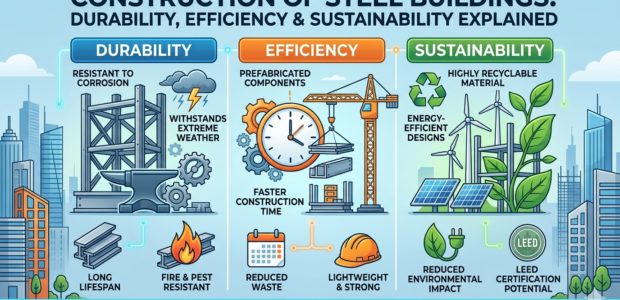

The construction industry has undergone significant transformation over the past few decades. As cities expand and businesses demand stronger, faster, and more sustainable building solutions, steel construction has emerged as one of the most reliable and forward-thinking methods available today.
From warehouses and manufacturing plants to retail centers and office complexes, the construction of steel buildings continues to grow in popularity across commercial, industrial, and even residential sectors. The reason is simple: steel offers unmatched durability, exceptional efficiency, and long-term sustainability.
In this comprehensive guide, we’ll explore:
- What steel construction involves
- Why steel buildings are known for durability
- Efficiency advantages in modern projects
- Environmental and sustainability benefits
- Cost-effectiveness over time
- Common applications across industries
- Why steel is shaping the future of construction
If you’re considering a new building project or simply want to understand why steel dominates modern development, this article will provide clarity.
What Is Steel Construction?
Steel construction refers to building structures using steel as the primary structural material. Instead of relying on traditional wood framing or reinforced concrete, steel buildings use:
- Structural steel beams
- Columns
- Steel framing systems
- Roof trusses
- Metal decking
- Pre-engineered steel components
Most steel components are fabricated off-site and assembled on location. This approach ensures precision manufacturing, faster installation, and reduced material waste.
Steel construction is widely used for:
- Industrial facilities
- Warehouses
- Retail spaces
- Agricultural buildings
- Commercial office complexes
- Educational institutions
- Healthcare facilities
The versatility of steel makes it adaptable to virtually any design requirement.
1. Durability: Why Steel Buildings Last Decades
One of the strongest advantages of steel construction is durability. Steel structures are engineered to withstand harsh conditions while maintaining structural integrity.
1.1 Strength-to-Weight Ratio
Steel has one of the highest strength-to-weight ratios among construction materials. This means:
- It can support heavy loads
- It allows for longer spans without interior columns
- It reduces foundation requirements
- It improves structural performance
Because of this strength, steel buildings maintain stability even under extreme stress.
1.2 Resistance to Environmental Damage
Unlike wood, steel is resistant to:
- Termites and pests
- Mold and mildew
- Warping and cracking
- Rot and decay
This resistance drastically reduces long-term repair and maintenance costs.
1.3 Fire Resistance
Steel is non-combustible. While it can lose strength under extreme heat, it does not fuel fires like wood does. Fire-resistant coatings and modern building techniques further enhance safety.
For commercial buildings where safety regulations are strict, steel offers a major advantage.
1.4 Weather & Disaster Resilience
Steel structures perform exceptionally well in:
- High winds
- Heavy snow loads
- Hurricanes
- Seismic activity (earthquakes)
Because steel can flex without fracturing, it absorbs stress during earthquakes better than many traditional materials.
2. Efficiency: Faster, Smarter Construction
Efficiency is a top priority in modern construction. Delays increase labor costs and reduce profitability. Steel construction addresses these challenges directly.
2.1 Faster Construction Timeline
One major advantage of steel construction is speed.
Since components are fabricated off-site:
- On-site labor is reduced
- Weather delays are minimized
- Construction schedules are shorter
- Projects reach occupancy faster
In commercial development, time equals money. Faster completion means quicker return on investment.
2.2 Precision Engineering
Steel components are manufactured in controlled environments using advanced technology.
Benefits include:
- Exact measurements
- Reduced human error
- Fewer structural inconsistencies
- Higher quality control
This precision improves overall building performance.
2.3 Reduced Construction Waste
Steel construction generates less material waste compared to traditional building methods.
- Fabrication is optimized
- Leftover steel can be recycled
- Minimal on-site cutting is required
Reduced waste supports environmental goals and lowers disposal costs.
2.4 Flexible Design Capabilities
Steel allows architects and engineers to create:
- Large open floor plans
- High ceilings
- Custom shapes
- Unique architectural features
Modern commercial spaces demand flexibility. Steel supports creative and functional design without compromising structural strength.
3. Sustainability: Steel as a Green Building Solution
Sustainability is no longer optional — it’s a priority for governments, developers, and consumers.
Steel construction aligns well with sustainable building practices.
3.1 100% Recyclable Material
Steel is one of the most recycled materials in the world.
- Most structural steel contains recycled content
- Steel can be reused without losing strength
- At the end of a building’s lifecycle, steel can be repurposed
This significantly reduces environmental impact.
3.2 Energy Efficiency
Steel buildings can be highly energy efficient when paired with proper insulation systems.
Benefits include:
- Reduced heating and cooling costs
- Improved thermal performance
- Lower carbon footprint
- Compliance with energy codes
Insulated metal panels and reflective roofing further enhance efficiency.
3.3 Lower Lifecycle Environmental Impact
Because steel buildings last longer and require less maintenance, they:
- Consume fewer resources over time
- Reduce repair-related emissions
- Limit reconstruction needs
Long lifespan equals long-term sustainability.
3.4 LEED and Green Certifications
Steel construction supports green building certifications such as:
- LEED (Leadership in Energy and Environmental Design)
- ENERGY STAR compliance
Developers pursuing sustainability benchmarks often choose steel for this reason.
4. Cost-Effectiveness Over Time
While some projects may see comparable upfront costs to traditional materials, steel offers superior long-term value.
4.1 Lower Maintenance Costs
Because steel resists pests, moisture, and decay:
- Repairs are minimal
- Structural integrity remains stable
- Maintenance budgets are lower
Wood structures may require frequent treatment and repairs — steel does not.
4.2 Insurance Savings
Steel buildings often qualify for lower insurance premiums due to:
- Fire resistance
- Structural reliability
- Reduced risk of catastrophic failure
Over decades, these savings add up significantly.
4.3 Longevity & Resale Value
Steel buildings can last 30–50+ years with proper maintenance.
Long lifespan increases:
- Property value
- Asset appreciation
- Investment return
For commercial investors, durability translates into financial stability.
5. Applications of Steel Construction
Steel buildings are used across various sectors due to their versatility.
5.1 Industrial & Manufacturing Facilities
Steel supports:
- Heavy machinery
- Large open production floors
- Overhead crane systems
- Tall clear-span ceilings
Industrial operations rely on steel for structural performance.
5.2 Warehouses & Distribution Centers
E-commerce growth has increased demand for large logistics hubs.
Steel construction enables:
- Rapid build times
- Wide interior spans
- Scalable expansions
- High structural load capacity
5.3 Retail & Commercial Buildings
Modern shopping centers and showrooms benefit from:
- Flexible interior layouts
- Modern exterior finishes
- Structural reliability
Steel allows customization without sacrificing strength.
5.4 Agricultural Buildings
Farmers and agricultural businesses prefer steel for:
- Barns
- Storage facilities
- Equipment shelters
Steel withstands environmental exposure better than wood.
5.5 Office Complexes
Mid-rise and multi-story office buildings often rely on steel framing for:
- Stability
- Safety
- Modern architectural aesthetics
6. Steel vs. Traditional Building Materials
Here’s a comparison:
| Feature | Steel | Wood | Concrete |
| Durability | Excellent | Moderate | High |
| Pest Resistance | Excellent | Poor | Excellent |
| Construction Speed | Fast | Moderate | Slower |
| Sustainability | High | Moderate | Moderate |
| Fire Resistance | High | Low | High |
| Maintenance Needs | Low | High | Moderate |
Steel offers the most balanced performance profile overall.
7. Addressing Common Concerns About Steel
Despite its advantages, some misconceptions exist.
Concern: Steel Rusts
Modern coatings and galvanization prevent corrosion effectively.
Concern: Steel Conducts Heat
Proper insulation eliminates this issue and improves energy performance.
Concern: Higher Initial Cost
When evaluating total lifecycle cost, steel often proves more economical.
8. The Future of Steel Construction
The construction industry is evolving toward:
- Prefabrication
- Modular building systems
- Sustainable materials
- Faster build times
- Smarter engineering
Steel aligns perfectly with these trends.
Advancements in:
- Coating technologies
- Structural engineering software
- Sustainable fabrication
- Hybrid building systems
…continue to strengthen steel’s dominance in the market.
Frequently Asked Questions
How long do steel buildings last?
Properly maintained steel buildings can last 30–50 years or more.
Are steel buildings energy efficient?
Yes. With proper insulation systems, steel buildings meet or exceed modern energy codes.
Is steel environmentally friendly?
Yes. Steel is recyclable, durable, and supports sustainable building practices.
Can steel buildings be customized?
Absolutely. Steel allows flexible architectural design and exterior finishes.
Is steel construction safe?
Yes. Steel provides exceptional strength, fire resistance, and seismic performance.
Final Thoughts
The construction of steel buildings represents the future of modern development. Combining durability, efficiency, and sustainability, steel construction provides a reliable solution for commercial, industrial, and agricultural projects.
Developers, architects, and business owners increasingly choose steel because it offers:
✔ Long-term strength
✔ Faster construction
✔ Lower maintenance
✔ Environmental responsibility
✔ Strong return on investment
As cities expand and sustainability becomes central to development strategies, steel construction will continue to lead the industry.
If you’re planning a building project, considering steel may be one of the smartest decisions you make.