
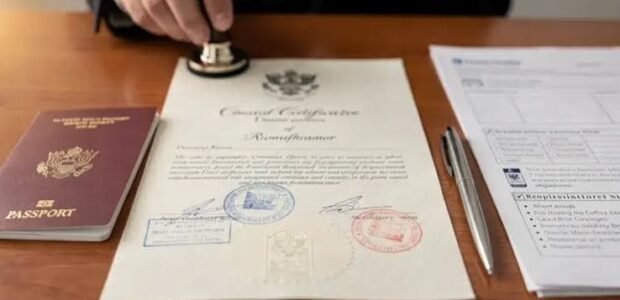

Quick answer: Legalizing foreign educational certificates for a residency visa involves document attestation, translation, and verification through official government channels. The process typically includes home country authentication, UAE Embassy attestation, and final Ministry of Foreign Affairs (MOFA) verification in the UAE.
Getting a residency visa in the UAE is a significant milestone. But if your educational qualifications were earned abroad, there is one step that trips up many applicants: certificate legalization. It sounds straightforward, but the process involves multiple government bodies, strict sequencing, and close attention to detail.
This guide breaks down exactly what you need to do to legalize your foreign educational certificates for a UAE residency visa. Whether you earned your degree in India, Pakistan, the Philippines, the UK, or anywhere else, the steps follow a similar path. Read on to understand the full process, avoid common mistakes, and learn how professional visa services can save you time and stress.
Why Do Residence Visa Services in Dubai Business Bay Require Legalized Certificates?
UAE authorities require legalized educational documents to confirm that your qualifications are genuine and recognized. This applies across many visa categories, including skilled worker visas, sponsored employment visas, and long-term residency visas. Residence Visa Services Dubai Business Bay can help applicants understand the documentation requirements and prepare their applications correctly.
The UAE has strict document verification standards. A certificate printed in another country carries no legal weight in the UAE until it has been authenticated through the proper channels. This process is called attestation or legalization, and it confirms that:
- The document was issued by a real, recognized institution
- The signature and seal on the document are authentic
- The document has not been forged or tampered with
Skipping or incorrectly completing this process can result in visa rejection, delays, or even a ban on reapplication. Understanding the correct steps from the start protects you from these risks.
Step-by-Step Guide to Legalizing Your Educational Certificates
Step 1: Notarization in Your Home Country
The first step happens before your documents leave your home country. You need to get your educational certificate notarized by a local notary public or the relevant government department in the country where the certificate was issued.
In many countries, this also involves getting the certificate authenticated or attested by the Ministry of Education or the equivalent national authority. This step confirms that the institution and the qualification are legitimate at the national level.
Helpful tip: Always work with original certificates, not photocopies. Some countries also require a certified true copy before notarization, so check local requirements.
Step 2: Attestation by the UAE Embassy or Consulate
Once your documents have been notarized and authenticated in your home country, the next step is to get them attested by the UAE Embassy or Consulate in that country.
This step is critical. The UAE Embassy stamp confirms that your home country’s authentication is valid and recognized. Without this stamp, UAE immigration authorities will not accept your documents, regardless of how many other attestations they carry.
Helpful tip: Processing times at UAE Embassies vary by country. Some offer express services for an additional fee. Plan this step at least three to four weeks before your intended visa application date.
Step 3: Ministry of Foreign Affairs (MOFA) Attestation in the UAE
After arriving in the UAE with your embassy-attested documents, your final step is to get them attested by the UAE Ministry of Foreign Affairs and International Cooperation (MOFAIC). This is the last official stamp your documents need before they are accepted for residency visa processing.
MOFA attestation can be completed through:
- The official MOFA website or app
- Approved typing centers and document clearing services
- UAE Visa Services Business Bay and other business hubs across the emirate
Helpful tip: Keep multiple certified copies of your documents at every stage. Original documents can be damaged or lost, and having copies speeds up any re-processing.
Step 4: Certified Translation (If Required)
If your educational certificates are not in Arabic or English, you will need a certified translation. In the UAE, this must be done by a translator licensed by the UAE Ministry of Justice.
Unofficial or online translations are not accepted. Always use a government-approved translation service to avoid rejection.
Step 5: Submission for Residency Visa Processing
With your fully attested and translated documents in hand, you can now submit them as part of your residency visa application. Your employer, sponsor, or a registered typing center will typically handle the submission to the General Directorate of Residency and Foreigners Affairs (GDRFA).
Common Mistakes to Avoid During Certificate Legalization
Many applicants run into problems because of easily preventable errors. Here are the most frequent ones:
- Skipping the home country authentication step: Sending documents directly to the UAE Embassy without proper home country notarization will result in rejection.
- Using expired attestations: Some attestations have a validity period. Make sure all stamps and seals are current.
- Submitting uncertified translations: Any translation that is not done by a MOFAIC-licensed translator will not be accepted.
- Wrong order of attestation: The sequence matters. Home country first, then UAE Embassy, then MOFA. Reversing or skipping steps invalidates the process.
How Long Does the Certificate Legalization Process Take?
The total timeline depends on your home country, the institution that issued your certificate, and the processing speed of each authority involved. On average:
- Home country notarization and authentication: 1 to 3 weeks
- UAE Embassy attestation: 1 to 4 weeks
- MOFA attestation in the UAE: 3 to 7 business days
The entire process can take anywhere from one month to three months. If you are on a tight deadline, professional document clearing and visa services can help expedite several of these steps.
Frequently Asked Questions
Do all residency visa types require educational certificate attestation?
Not always. The requirement depends on your visa category. Employment-based visas and skilled residency visas typically require attested educational certificates. Family sponsorship visas may not. Check with your employer or a registered visa service to confirm what your specific visa category requires.
Can I start the attestation process while already in the UAE?
For the home country steps, you will need a representative or a document clearing service to handle the process on your behalf. The MOFA step can be completed once you are in the UAE. Many document services offer remote handling for international attestation.
What happens if my university no longer exists or has changed its name?
This is more common than many people expect. In such cases, you may need a letter from the relevant national education authority confirming the institution’s history and the legitimacy of your certificate. A document clearing service can advise you on the exact steps for your country and institution.
Are degrees from all countries accepted for UAE residency visas?
The UAE recognizes qualifications from most countries, but some degrees may require additional verification through the UAE’s Qualifications Framework. Degrees from institutions not recognized by the home country’s education authority may not be accepted.
Can a professional service handle the full legalization process for me?
Yes. Registered visa and document services operating across the UAE can manage the entire process, from home country attestation through to MOFA certification. This is especially useful if you are unfamiliar with the process or are applying from outside the UAE.
Final Words
Legalizing your foreign educational certificates is not a formality you can skip or rush. It is a structured, sequential process that requires careful attention at every stage. Getting it right the first time saves you weeks of delays and protects your visa application from unnecessary rejection.
If the process feels overwhelming, reaching out to a trusted visa and document clearing service is a smart move. Professionals familiar with the UAE’s requirements can guide you through each step, handle paperwork on your behalf, and flag potential issues before they become serious problems.
Start the process early, keep copies of everything, and make sure every step is completed in the correct order. Your residency visa is worth getting right.