

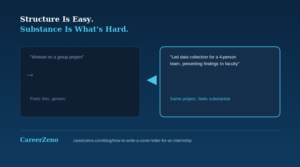
Most guidance on how to write a cover letter for an internship focuses on structure — opening, body, closing — without addressing the harder question underneath: what actually goes in those sections when the applicant doesn’t have much of a professional track record yet. Structure alone doesn’t solve the substance problem.
Why Structure Advice Only Gets You So Far
Knowing that a letter should open with interest in the role, move into supporting evidence, and close with enthusiasm is useful, but it’s also fairly generic guidance that dozens of other applicants are following in exactly the same way. The letters that actually stand out aren’t distinguished by better structure — they’re distinguished by what fills that structure.
The Real Challenge for Internship Applicants Specifically
Unlike an experienced professional with years of achievements to draw from, most internship applicants are working with a much smaller pool of material — coursework, a handful of projects, maybe a part-time job unrelated to the target field. The real skill isn’t following a template; it’s identifying which pieces of that smaller pool are actually worth featuring, and framing them with enough specificity to feel substantial.
What Makes Limited Experience Feel Substantial
A class project described vaguely (“worked on a group project”) feels thin. The same project described with real detail — the specific problem, the applicant’s specific role, a concrete outcome — feels legitimate, even though the underlying experience is exactly the same. The gap between thin and substantial is almost entirely about specificity, not about the scale of the experience itself.
Why Genuine Reasoning Beats Generic Enthusiasm
A letter that explains a specific, genuine reason for interest in a particular opportunity reads as far more credible than one relying on general enthusiasm that could apply to any similar company. This specific reasoning is often the single most differentiating element in an otherwise template-following letter.
Bringing It Together
Combining specific, well-framed evidence with genuine, particular reasoning — inside a reasonably standard structure — is what actually produces a letter that stands out, more than any structural trick or clever opening line ever could.
CareerZeno guide on how to write a cover letter for an internship goes beyond basic structure to help applicants identify and frame the substance that actually makes a letter memorable.
Structure is the easy part, and most guides stop there. The harder, more valuable skill is knowing what to put inside that structure when experience is still limited.